Why do most forex robots fail and how does AI trading work differently?
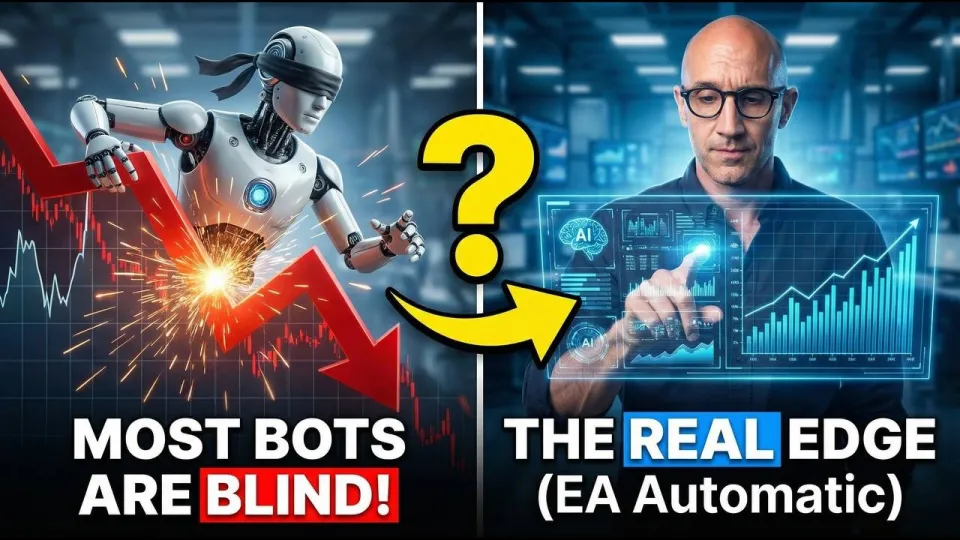
Video: Forex Robot | Why Most Trading Bots Fail & How AI Trading Works Differently
· based on the channel Spartak0s1992
Key takeaways
- Traditional forex robots rely on fixed indicator rules that break when market volatility or spreads change.
- Weekend gaps and news spikes often trigger stop-losses or false signals in rule-based bots.
- AI-powered forex robots use machine learning and data from over 300 experienced traders to adapt to market context.
- Adaptive risk management and volatility analysis help AI bots size positions and avoid trading during unfavorable conditions.
- Backtesting alone is insufficient; forward testing and understanding the bot's logic are essential for success.
Most forex robots fail because they rely on fixed rules that cannot adapt to changing market conditions. AI-powered trading bots address this by using machine learning and data from over 300 experienced traders to make context-aware decisions. You can explore a free AI robot demonstration through this link to see how adaptive systems differ from traditional expert advisors.
Why do most forex robots fail in live trading?
Most forex robots fail in live trading because their strategies are built on static rules that do not account for shifting volatility, spreads, and market regimes. A typical EA might buy when a moving average crossover occurs, but that signal can produce whipsaws in ranging markets or during news events. Weekend gaps and sudden liquidity drops often trigger stop-losses or false entries that the robot cannot interpret. Additionally, many commercial robots are optimized on historical data, leading to curve-fitting: they perform well in backtests but break down when real market conditions deviate. Without adaptive risk management, a single adverse move can wipe out gains. The core issue is the lack of context—robots treat all price movements equally, ignoring whether the market is trending, ranging, or reacting to news.
How does an AI forex robot use machine learning to trade differently?
An AI forex robot uses machine learning to analyze market context, volatility, and patterns from a large dataset of trading decisions, allowing it to adjust its behavior dynamically. Instead of fixed if-then rules, it continuously evaluates multiple inputs—price action, volatility, time of day, and even the behavior of experienced traders—to generate signals. For example, EA Automatic, mentioned in the video, leverages data from over 300 experienced traders to train its models. This means the AI can recognize when conditions resemble past successful setups and avoid trades when uncertainty is high. It also incorporates automated risk management, adjusting position sizes based on current volatility and account equity. The result is a system that adapts to changing markets rather than assuming they stay the same.
What are the key differences between traditional forex robots and AI trading bots?
Traditional forex robots follow rigid indicator-based rules, while AI trading bots use probabilistic models and context to make decisions. Traditional robots are often built on a single strategy, such as breakout or mean reversion, and apply it uniformly across all market conditions. AI bots, in contrast, can switch between strategies or adjust parameters in real time based on learned patterns. They also incorporate risk management that considers the broader market environment, such as avoiding trades during low liquidity or high spread periods. Another difference is data usage: traditional robots rely on price data alone, whereas AI systems may integrate multiple data sources, including trader sentiment and volatility metrics. This makes AI bots more robust to changing conditions but also more complex to develop and validate.
How can you evaluate a forex robot before using it live?
Evaluating a forex robot requires more than a backtest; you need to understand its logic, test it on out-of-sample data, and monitor its behavior in a demo account. Start by reviewing the robot's strategy description and checking if it uses adaptive elements or fixed rules. Run a backtest on historical data that includes different market regimes, but be aware of curve-fitting. Then, forward-test the robot on a demo account for at least 3–6 months to see how it handles real spreads and slippage. Check the maximum drawdown and risk per trade. Finally, consider the developer's transparency—does the robot explain its decisions? AI-based systems like EA Automatic offer insights into how they use trader data and volatility analysis, which can help you assess their reliability.
What role does risk management play in AI forex trading?
Risk management is central to AI forex trading because it determines how much capital is exposed per trade and how the system responds to adverse conditions. AI robots can dynamically adjust lot sizes based on volatility, reducing exposure when markets are erratic and increasing it when conditions are favorable. They can also set adaptive stop-losses and take-profits that account for current market noise. Moreover, AI systems can avoid trading during high-impact news events or when spreads widen, which traditional robots often ignore. Automated risk management also includes monitoring overall portfolio risk, ensuring that no single trade or sequence of trades can cause significant damage. This adaptive approach helps preserve capital during drawdowns and allows the system to survive long enough to benefit from favorable periods.
Where can you access an AI forex robot for testing?
You can access a free AI forex robot demonstration through the link provided by the video's author, which offers a way to test the system without initial cost. The link https://smarttradingsystem.net/F3XJN64z leads to a page where you can get the robot for free and see how it uses data from over 300 traders. This allows you to evaluate its performance in a demo environment before committing real funds. Always ensure you understand the terms and risk disclosures before using any automated trading system.
Conclusion: why AI trading bots offer a different approach
AI trading bots address the core weaknesses of traditional forex robots by adapting to market context and incorporating dynamic risk management. They move beyond fixed indicators to learn from data and adjust in real time, which can improve resilience in changing conditions. However, no robot is foolproof, and thorough testing remains essential. For a hands-on look at an AI forex robot, you can get it for free via this link. The video breakdown by Spartak0s1992 provides further insights into why most bots fail and how AI trading works differently.
Source: Forex Robot | Why Most Trading Bots Fail & How AI Trading Works Differently · Markdown version
Questions & answers
What makes AI forex robots different from traditional expert advisors?
AI forex robots use machine learning to analyze market context and adapt their strategies, while traditional expert advisors rely on fixed indicator rules. This allows AI bots to adjust to changing volatility and avoid trades during unfavorable conditions.
Can a forex robot guarantee profits?
No forex robot can guarantee profits. Market conditions are unpredictable, and even AI-powered systems can experience losses. Proper risk management and realistic expectations are essential.
How much data is needed to train an AI forex robot?
The amount varies, but systems like EA Automatic use trading data from over 300 experienced traders to train their models. This large dataset helps the AI recognize patterns and make more informed decisions.
Is it safe to use a free forex robot?
Free forex robots can be safe if they come from reputable developers and you test them on a demo account first. Always check for transparency in strategy and risk management before using real funds.